
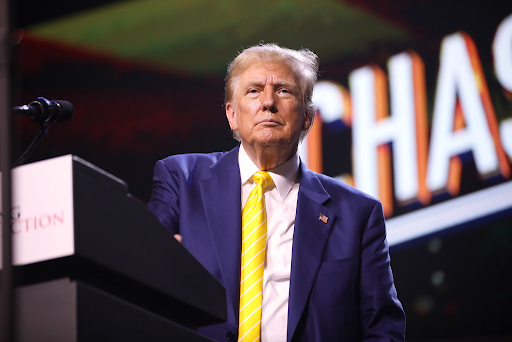
President Trump turned a legal setback into an aggressive new trade offensive Saturday, announcing a 15% tariff on all imports and renewing his accusations that foreign nations have exploited the United States in trade for decades. The announcement came less than 24 hours after the Supreme Court invalidated his previous tariff framework.
Using Section 122 of the Trade Act of 1974 — a provision that permits tariffs of up to 15% for 150 days — Trump declared the new levy effective immediately and framed it as a legitimate and overdue correction to unfair global trade practices. His administration plans to use the 150-day period to build a legally durable long-term tariff policy.
The Supreme Court had ruled 6-3 on Friday that Trump’s IEEPA-based tariffs were unconstitutional without congressional authorization. Trump lashed out, calling the decision “ridiculous, poorly written, and extraordinarily anti-American,” and directing intense personal criticism at justices in the majority, particularly his own nominees Amy Coney Barrett and Neil Gorsuch.
World leaders struck a conciliatory tone. Germany’s Chancellor Merz warned that constant uncertainty over tariffs was economically toxic and pledged to bring a coordinated European response to Washington. France’s Macron reaffirmed the importance of reciprocity in trade, rejecting unilateral policy shifts. The UK, previously at a 10% rate, now finds that arrangement in doubt.
US consumers have borne about 90% of the more than $130 billion collected in tariffs so far, according to research data. The new 15% rate will deepen that burden unless exemptions apply — which they do for critical minerals, metals, pharmaceuticals, and USMCA goods. Sector tariffs on steel, aluminum, lumber, and autos remain unaffected and fully in force.