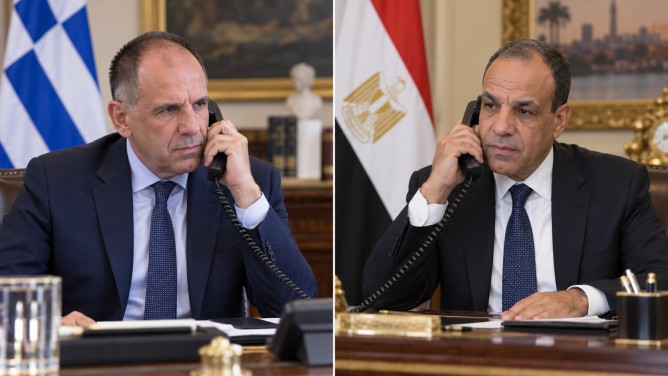
Greece and Egypt are preparing to negotiate an extension of their exclusive economic zone (EEZ) agreement in the Eastern Mediterranean, a move that could heighten regional tensions over maritime claims. The initiative, discussed in a telephone conversation between Greek Foreign Minister George Gerapetritis and Egyptian Foreign Minister Badr Abdelatty, comes amid ongoing disputes involving Turkey and Libya.
The current maritime boundary agreement between Greece and Egypt, signed in August 2020, establishes an EEZ between the 26th and 28th meridians. The proposed extension would shift the boundary eastward, impacting waters beyond the 28th meridian, which intersects the island of Rhodes. This development follows Libya’s recent ratification of a maritime agreement with Turkey, further complicating the geopolitical landscape in the region.
Athens and Cairo have jointly criticized the Turkish-Libyan memorandum, arguing that it fails to adequately consider islands in determining maritime boundaries. This principle is a key point of contention, as both Greece and Egypt maintain that islands should play a significant role in such determinations. Technical consultations between the two countries are expected to commence soon to advance discussions on the EEZ extension.
In response to the Turkish-Libyan agreement, Greece plans to engage the European Union and the United Nations, seeking a unified international stance on the issue. Meanwhile, Turkey has defended its agreement with Libya, asserting that external evaluations cannot invalidate their bilateral deal.
The talks between Greece and Egypt underscore the persistent disagreements over maritime jurisdiction and influence in the Eastern Mediterranean, with multiple nations vying for strategic and economic advantages in the region. As the negotiations progress, the outcome could significantly impact regional dynamics and international relations.