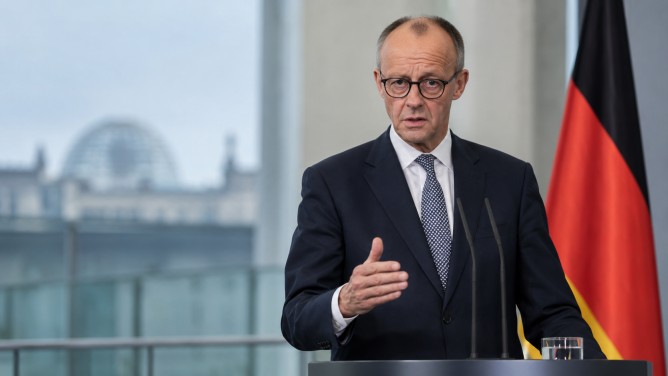
The recent regional elections in Germany have underscored significant shifts in the political landscape, with Chancellor Friedrich Merz’s Christian Democratic Union (CDU) facing considerable setbacks. This development is likely to intensify internal debates within the party about its leadership and strategy as the Alternative for Germany (AfD) continues to gain momentum, especially in the eastern regions.
In Berlin, the left-wing Die Linke emerged as the dominant political force, securing approximately 25.7% of the vote. The CDU trailed with 18.8%, while the AfD captured around 16.3%, marking a notable rise in its influence. The situation was more dramatic in Mecklenburg-Western Pomerania, where the AfD claimed the largest share of votes at about 38.2%, narrowly surpassing the Social Democrats who garnered 35.5%. The CDU, however, managed only 4.9%, falling below the threshold required for representation in the state parliament.
These electoral outcomes have added pressure on Chancellor Merz, who already faced challenges following the AfD’s strong performance in Saxony-Anhalt earlier this month. Despite these setbacks, Merz has committed to maintaining his position and pursuing his administration’s economic and social reform agenda.
The elections have highlighted growing political divisions within Germany, with the AfD solidifying its position in the eastern states, while Die Linke gained traction in urban centers like Berlin. This polarization is expected to spark further discussions within the CDU about the direction it should take to regain voter confidence.
The results reflect a broader trend of political realignment in Germany, with traditional parties like the CDU struggling to maintain their foothold amid rising support for both far-right and far-left parties. As the political landscape continues to evolve, the CDU will need to reassess its strategies to address the shifting preferences of the German electorate.